


While the world’s farms advance, its forests retreat. Have you ever noticed plumes of grey smoke wafting up from our mountains? You’ve probably seen the effects of kaingin, a traditional and widely-practiced farming system for upland areas. Practiced in over 50 countries, kaingin sees forests cut down, burnt and replaced with cash crops – usually drought-resistant rice, corn or cassava.
Unless you live up the misty mountains of the Cordilleras or Bukidnon, it’s easy to imagine the Philippines as being relatively flat. Driving outside most Pinoy towns reveals sprawling palayan or ricefields, nursed by dikes and canals.
In reality, 65% of the country’s land area is comprised of mountains, which shelter the majority of Philippine terrestrial or land-based biodiversity. Once protected by inaccessibility, many upland areas can now be seen being encroached upon by agriculture, whether legal or not. Drone footage and satellite images now show many Philippine forests pockmarked with kaingin plots and small upland farms.
“The continuous encroachment of unregulated and unsustainable agriculture in our mountains, particularly inside Protected Areas, can drastically reduce the many benefits we derive from nature – from clean water and harvestable forest products like rattan – to temperature regulation and natural flood-control,” says Mariglo Rosaida Laririt, Assistant Director of the Department of Environment and Natural Resources Biodiversity Management Bureau (DENR-BMB).
To steer upland farming towards more sustainable practices, the DENR and Department of Agriculture (DA) are jointly implementing an emerging program to mainstream Biodiversity-friendly Agricultural Practices (BDFAPs), both in Protected Areas and wider agricultural landscapes.
In partnership with the United Nations Development Programme’s Biodiversity Finance Initiative (UNDP-BIOFIN), lobbying and collaborations are being conducted to promote the repurposing of agricultural subsidies with potential environmental footprints gearing towards biodiversity-friendly farming practices.
Reallocating Farming Subsidies
Agricultural subsidies are government incentives meant to support farmers by supplementing income, managing the supply of farm products and influencing the cost of growing and selling crops.
Examples include discounts or rebates for fertilizers, genetically-modified seedstock or pesticides – all meant to keep local production viable. Theoretically, subsidies minimize import reliance and help steer the country towards self-sufficiency. Philippine agricultural subsidies averaged PHP3.36 billion yearly from 2010 to 2015.
However, a study conducted by various United Nations agencies found that 87% of USD 540 billion in global agricultural subsidies are harmful to nature and health. For instance, agricultural subsidies have led to rapid deforestation in developing countries like Malawi and Brazil. Reallocating these subsidies to support sustainable food production for upland farms can minimize the effects of upland farming in the country’s mountainous areas.
Current farming systems can be ecologically detrimental when applied to upland farms. A paper published this year revealed how monocropping or planting a single dominant cash crop like pineapple, cacao or coffee often leads to biodiversity and water loss, plus severe soil erosion that causes destructive floods in lowland areas.
“Whereas traditional farming systems rotate dif
ferent crops, monocropping often relies on external inputs like chemical fertilizers and pesticides to optimize production,” says Muneer Hinay, co-founder of Kids Who Farm. “By applying solutions like intercropping and rotating crops, farm ecosystems are diversified, soil fertility is restored and production resources are optimized. This helps cushion the long-term impacts of commodity price fluctuations while allowing a greater variety of food to be grown.”
New Markets for Mountain Crops
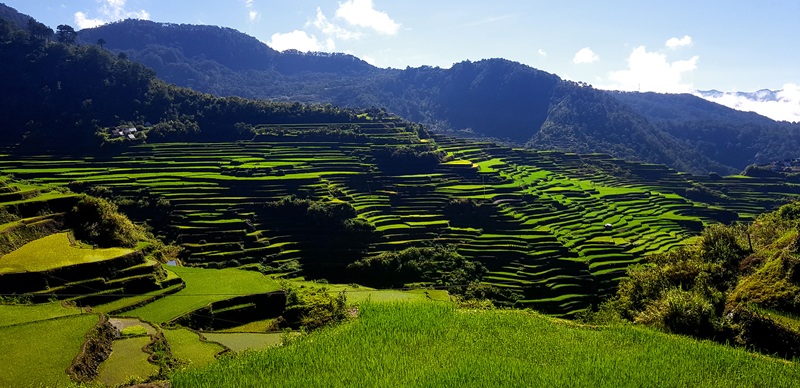
Deep in the Cordillera region rise sheer-sided hills that produce mountains of rice. Unique and centuries-old upland structures of Cordilleran Rice Terraces, including the inscribed sites in the UNESCO World Heritage List, embody the engineering skill and artistry of the country’s indigenous highlanders.
Irrigated by elaborate canals from the peaks of cloud forests, these rice terraces are formed by thousands of terraced rice ponds, hemmed in by stone and mud. The cultivars or native varieties of rice grown in various parts of the Region are found nowhere else on Earth – red-grained Ulikan tastes earthy, Ominio is sticky and black-grained, lnuruban is greenish-gray and used for sticky rice cakes.
“Agricultural subsidies for instance can be used to buoy native upland products like heirloom rice and other uniquely marketable Pinoy grains like Adlai. Like biodiversity, indigenous farming skills should be protected,” explains Anabelle Plantilla, National Project Manager for UNDP-BIOFIN in the Philippines. Variety is good for biodiversity, with each cultivar or species optimized for a specific niche. “Subsidies can also encourage more women and the youth to return to farming. In a world of call centers and remote jobs, few young Pinoys want to till the land their families have for generations. Repurposed subsidies can make farming a lucrative enterprise again.”
BIOFIN is a global UNDP initiative across 41 countries with funding from the European Commission and the Governments of Germany, Switzerland, Norway, Belgium, Flanders, the United Kingdom, Canada and France. It contributes to closing the financing gap for the conservation and sustainable use of biological diversity by identifying, accessing, combining and sequencing sources of biodiversity funding.
In the Philippines, BIOFIN is working with the DENR to narrow the financing gap for the implementation of the Philippine Biodiversity Strategy and Action Plan (PBSAP), the country’s roadmap to conserving its biodiversity. It is also working with the DA to balance agriculture and biodiversity conservation.
Currently in its planning stages, the reallocation of agricultural subsidies can strengthen and scale up the implementation of BDFAPs and key safeguard measures, including soil conservation, multiple cropping, the protection of biologically-important pollinators like bees and butterflies, plus other existing standards and certifications such as Organic Agriculture (OA), plus Good Agricultural Practices (GAP), which are standards for sustainable, safe and top-quality food production.
With 117 million mouths to feed and an ever-growing population, the Philippines must continuously produce more and more food. However, it should never sacrifice its mountains and other key biodiversity areas that provide people and nature with critical ecological services like irrigation, water regulation and flood control.
With runaway climate change disrupting natural seasonal cycles, the decreasing number of youths involved in agriculture, plus a growing reliance on intensive, fertilizer and pesticide-reliant production, more Philippine mountains and upland areas might be converted into farmland via kaingin.
With the right contextual factors, youth involvement in agriculture is definitely feasible. By supporting this move and by carefully repurposing agricultural subsidies, upland farms can be transformed into sustainable, agroforestry-based livelihood systems that simultaneously generate food while keeping ecological integrity intact. Now that’s food for thought.
1 Comment
I recently explored Cricbet99, and I must say the platform feels smooth and professional. The Cricbet99 login was quick, and creating my Cricbet99 ID was super easy. The Cricbet99 app works perfectly on my phone — no lag or crashes. I tried my luck in the Cricbet99 live casino and really enjoyed the experience. Hoping for more Cricbet99 win moments soon as I continue playing with the Cricbet99 club community.
To know more visit : https://officialcricbet99.com/